
There’s something satisfying about seeing something that shouldn’t be there. A giant product appearing in the middle of a shopping centre. An animated object interacting with a real building. Something flying through a familiar location as if it could have happened. That’s the appeal of a mixed reality social video.
By combining real-world footage with CGI, animation and visual effects, we can create content that feels surprising, playful and made to stop the scroll.
And while AI is becoming an increasingly useful tool in content creation, it’s not the secret behind these videos. Most of the work is built using traditional CGI, animation and compositing techniques.
Start with the real world
The trick with mixed reality is that the effect needs to feel like it belongs in the scene. That means the creative process starts before we open After Effects.
When we’re shooting footage for this type of content, we’re thinking about where the CGI will eventually sit. Camera movement, perspective, lighting, scale and the surrounding environment all become part of the brief.
Rather than shooting something and figuring out the effect afterwards, we capture the footage specifically to give the animation something believable to interact with. It’s a bit like building a stage for the CGI to perform on.
Making the impossible feel believable
Once we have the footage, we then use CGI and animation to create the elements that don’t exist in the real world, before bringing everything together in After Effects.
The aim isn’t necessarily to make something look completely photorealistic. In fact, sometimes a deliberately graphic or stylised visual makes the idea more interesting. What matters is that the different elements feel like they belong together.
Getting that right can come down to relatively small details: matching the camera movement, getting the scale right, adding the right shadows and reflections, or making sure an object passes behind something rather than simply appearing over the top of it. Those details are what make a piece of CGI feel like it’s actually happening.
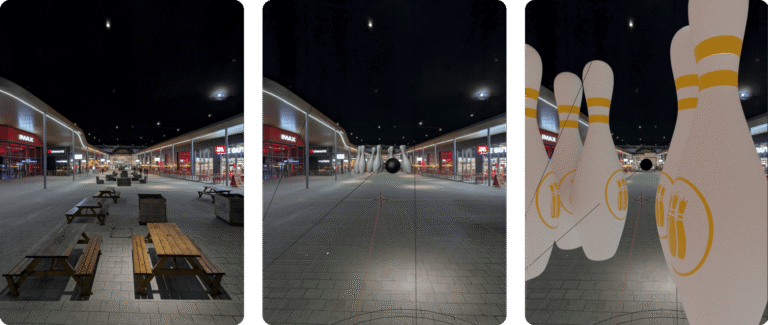
Here’s a behind-the-scenes look at some of the setup work for the bowling mixed reality social video we created for White Rose Shopping Centre.
Where AI does fit in
AI is naturally part of the conversation around this type of content creation, but it’s not the reason these videos work. For the majority of our examples, the creative and production process has been based around CGI, animation, live-action footage and compositing.
We have experimented with AI on a couple of projects, too, where it made sense for the idea. But the technology is only one part of the process. The interesting bit is still the creative thinking behind it: what could we put into this environment that people wouldn’t expect to see?
Built for social
Mixed reality works particularly well on social because the idea can be understood almost instantly. You don’t necessarily need a long explanation or a complicated story.
Someone scrolling through their feed sees something familiar, notices that something isn’t quite right, and wants to know what they’re looking at. That moment of recognition is often the hook.
And because the content is designed for social from the outset, we can think about the format, pacing, framing and opening seconds alongside the creative idea rather than trying to turn a traditional piece of video into a social asset afterwards.
So, what could you put in the real world?
That’s probably the most interesting question.
Mixed reality gives brands a way to take a familiar location, product or situation and add something unexpected to it. It could be a product made enormous. A character interacting with a building. An installation that doesn’t actually exist. Or something completely surreal that gives people a reason to stop, watch and share.
The best examples start with the idea, not the effect. And the technology just gives us more ways to bring that idea to life.
If you’ve got something you’d like to make appear in the real world, get in touch with the design team.